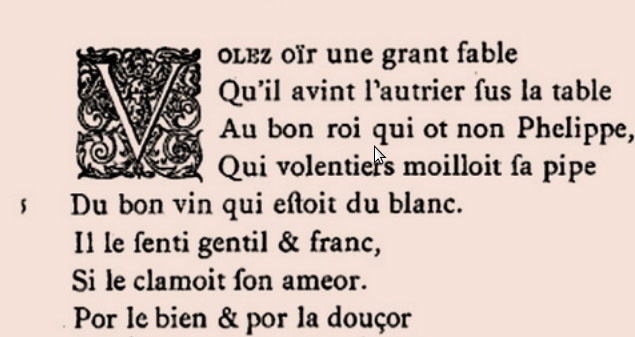

Chauvigny appears in the medieval poem commonly known as the “Battle of the Wines”, by the 13th-century Norman poet Henri d’Andeli. The Old French extracts below are followed by a free prose translation.
In the poem, the finest white wines are brought to Paris and presented to King Philip Augustus, an enthusiastic drinker.
Qui volentiers moilloit fa pipe Du bon vin qui eftoit du blanc. Il le fenti gentil & franc, Si le clamoit fon ameor. Por le bien & por la douçor Que li vins avoit dedenz foi, Li rois en but fanz avoir foi.
He gladly drank the good white wine, found it fine and honest, and proclaimed his love for it. Such was its goodness and sweetness that he drank even when he was not thirsty.
An English priest judges the wines, and the surviving contenders argue to outdo their rivals.
The wines of Berry advance against those of the Île-de-France, with Chauvigny at their head.
Chauveni, Montrichart, Laçoy, Chaftel Raoul & Befançoi, Monmorillon & Yfoudun Furent devant le roi tôt un Por abatre le bobançois De treftos nos bons vins françois.
Chauvigny, Montrichard, Lassay, Châteauroux, Buzançais, Montmorillon and Issoudun came before the king together to challenge the pride of the French wines.
The wines of the Île-de-France reply!
Vin françois bien fe deffendoient
Et cortoifement refpondoient :
« Se vous eftes plus fort de nous,
« Nous fommes fade, favorous ;
« Si ne fefons nule tempefte
« A cuer, n’a corz, n’a oeil, n’a tefte.
« Mès Vermentun, S. Brice, Auçuerre
« Si font les genz gefir au fuerre. »The French wines defended themselves politely: you may be stronger, but we are gentle and full of flavour. We do not trouble the heart, body, eyes or head, whereas the wines of Saint-Bris and Auxerre leave their drinkers lying on the straw.
The argument grows fierce.
Qui la veïft vins eftriver, Et chafcun fa force aviver, Et chafcun mener fon defroi Sor la table devant le roi, Ce n’est ore ne plus ne mains Se vin eüffent piez ne mains
The wines argued, each displaying its strength and defending itself on the king’s table. Had they possessed hands and feet, they might have killed one another.
After tasting the rivals, the king rewards his favourites.
Li rois les bons vins corona Et a chafcun fon non dona. Vin de Cypre fift apoftoile Qui refplendift comme une eftoile ; Dont fift chardonal & légat Du bon gentil vin d’Aquilat ; Puis fift . iij. rois & puis . iij . contes Et puis en dura tant li contes Qu’il en fift . xij . pers en France Ou li rois out moult grant fiance.
The king crowned the good wines and gave each a title. Cyprus became a pope shining like a star, Aquilat a cardinal and legate. He appointed three kings, three counts and finally twelve peers of France.
Those without the money to taste the winning wines may still take comfort.
Qui miex ne puet, fi n’a pas tort, Adès o fa vielle fe dort. Soit vin moien, per ou perfone, Prenons tel vin que Diex nous done.
If nothing better is available, there is no shame in enjoying what one has. Common wine or noble wine: let us take the wine God gives us.